
Your Quick-Start Guide to Holistic Dog Care Practices in Portland: Do This First
- Green Acres K-9 Resort
- Apr 29
- 5 min read

If you’ve been walking your pup through the trails near Boring or taking a weekend stroll through Powell Butte, you’ve likely heard the term "holistic care" buzzing around the local dog parks. In our neck of the woods: around Boring, Damascus, and the greater Portland area: we really value the natural way of life. But when it comes to our four-legged family members, the word "holistic" can sometimes feel a bit vague or even a little "woo-woo."
At Green Acres K-9 Resort, we believe that holistic care isn't about replacing science; it’s about using all the science available to us to make sure our dogs live their happiest, longest lives. Whether we are scooping poop in the morning dew or preparing fresh meals for our boarders, we see every day how a comprehensive approach to wellness changes a dog's spirit.
So, if you’re looking to dive into holistic practices but don’t know where to start, here is your quick-start guide. And spoiler alert: the "first step" might be simpler than you think.
The "Do This First" Step: Find Your Integrative Partner
Before you buy a single supplement or change a gram of kibble, the very first thing you should do is consult with an integrative veterinarian. Holistic care is most effective when it is integrative: meaning it combines the best of conventional Western medicine (like vaccines and surgery) with complementary therapies (like acupuncture, herbal medicine, and nutrition).
In the Portland area, we are incredibly lucky to have some of the best minds in the business. Practitioners like those at Irvington Veterinary Clinic or mobile experts like Dr. Darcy Hoyt offer a balanced approach that looks at the "whole dog" rather than just a single symptom.
The Science Behind It: Peer-reviewed research suggests that integrative approaches can be particularly effective for chronic pain management. For instance, a study published in the Journal of the American Veterinary Medical Association found that acupuncture, when used alongside traditional medicine, significantly improved mobility and quality of life in dogs with osteoarthritis (Lane & Hill, 2016). Starting with a professional ensures that your holistic journey is safe and backed by data.
Step 2: Look in the Bowl (The Foundation of Nutrition)
At Green Acres K-9 Resort, we are obsessed with what goes into our dogs' bellies. We truly believe that food is the first medicine. If you’ve visited our Farm Fresh Food page, you know we prioritize species-appropriate nutrition.
Most holistic journeys start with moving away from highly processed, high-heat "burnt" brown balls (kibble) toward whole-food-based diets. Even if you aren't ready for a full raw or gently cooked diet, adding "toppers" like fresh blueberries, steamed broccoli, or a bit of local pasture-raised egg can make a world of difference.
The Science Behind It: Research into the canine microbiome has exploded in recent years. A study in Scientific Reports (2021) highlighted that dogs fed a non-processed diet (raw or cooked whole foods) had a more diverse and stable gut microbiome compared to those on ultra-processed diets. A healthy gut means a stronger immune system and even better behavior, as the "gut-brain axis" is very real in our canine friends.

Step 3: Environmental Enrichment and "The Sensory Garden"
Holistic care isn't just about what a dog eats or the medicine they take; it’s about their environment. Here in Boring, we have the space to let dogs be dogs. We’ve found that giving a dog "sensory jobs" reduces stress and anxiety.
One of the easiest holistic shifts you can make at home is creating a sensory-rich environment. This doesn't mean buying more toys. It means letting them sniff. In the dog world, "smelling is seeing."
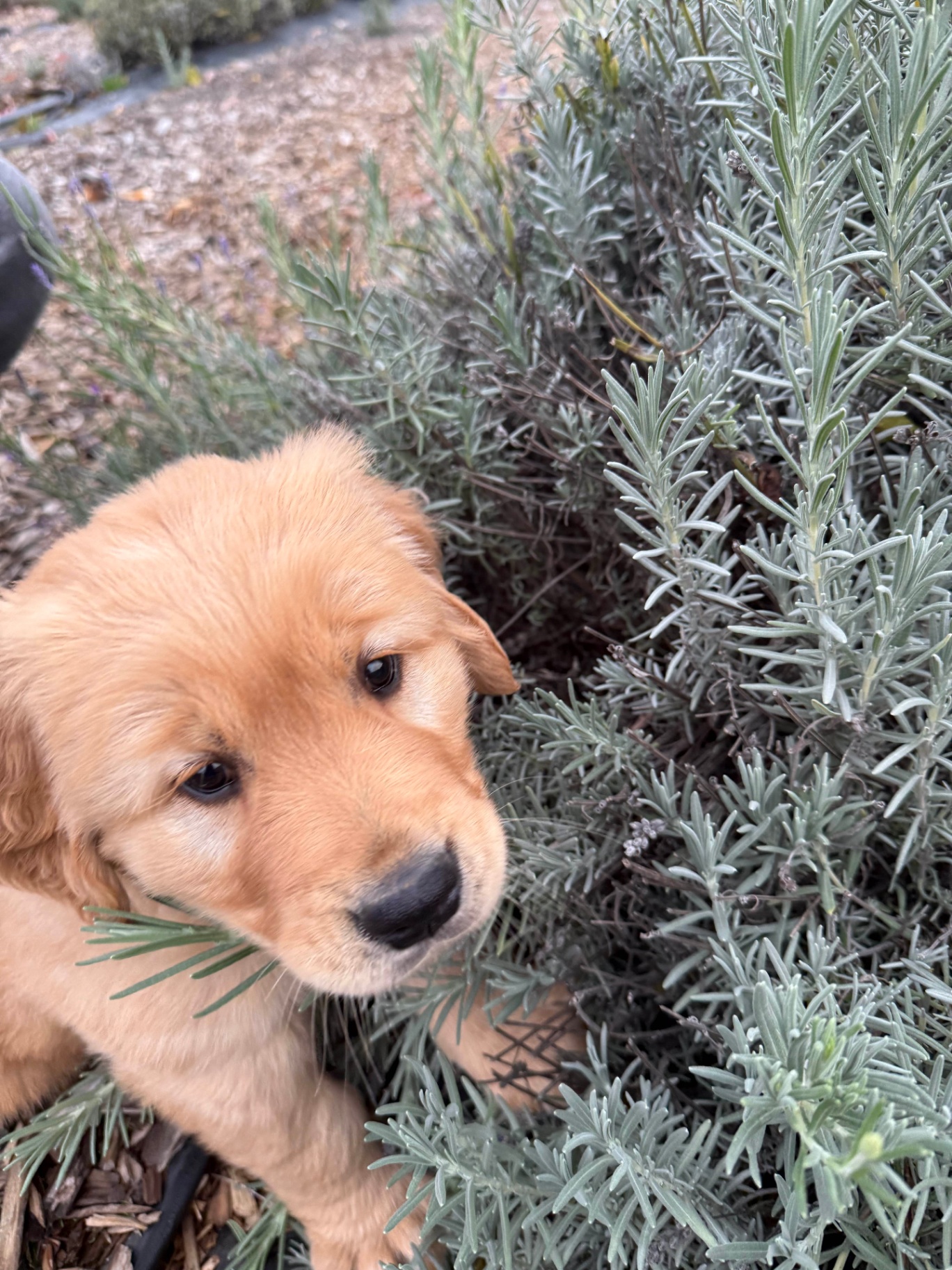
A Golden Retriever puppy exploring a lavender bush: this kind of sensory enrichment is a core part of our holistic philosophy.
At the resort, we love seeing our pups interact with the natural world. If you look at our daycare sessions, you'll see dogs exploring grass, dirt, and plants. This isn't just "play": it's a biological necessity.
The Science Behind It: Studies in Applied Animal Behaviour Science have shown that "nose work" and environmental enrichment significantly lower cortisol levels (the stress hormone) in dogs. By allowing your dog to engage in natural foraging and sniffing behaviors, you are holistically supporting their endocrine and nervous systems.
Step 4: Socialization as a Wellness Tool
We often think of dog socialization as just "making friends," but from a holistic perspective, it's about mental health. Isolation is a major stressor for a pack animal.
However, holistic socialization doesn't mean throwing your dog into a chaotic 50-dog park. It means curated, supervised interactions where the dog feels safe. We keep our playgroups small and focused on personality matches because we know that a stressed dog is an unhealthy dog.
The Science Behind It: Social isolation in social mammals has been linked to increased inflammation and oxidative stress. Conversely, positive social interactions trigger the release of oxytocin, which promotes healing and emotional bonding (Nagasawa et al., 2015).
The Home Integration Tip: The "Sniffari" Walk
Since we want you to feel empowered to start this journey today in your own Boring or Gresham backyard, here is a practical tip: The 15-Minute Sniffari.
Instead of your usual brisk walk where you might pull your dog away from every fire hydrant or blade of grass, give them 15 minutes of "dog-led" walking. Let them choose the path and let them sniff for as long as they want. This is a holistic "brain workout." It lowers their heart rate and satisfies their natural instincts more than a two-mile run ever could. We do this with our own pets and the dogs in our boarding program, and the "post-sniff" nap is always the deepest.
Why This Matters to Us
We aren't just a business; we’re a family of dog lovers. We know the anxiety of wanting to do the "right" thing for your pet when there is so much conflicting information online. We’ve been there: worrying about our own kids and our own aging pups. That’s why we lean on science and nature. We believe that by looking at the whole picture: vet care, food, environment, and social life: we can give our dogs a life that isn't just long, but vibrant.
If you ever have questions about how we integrate these practices during your dog's stay, feel free to check out our FAQ or just give us a holler. We’re always here to help our Portland-area neighbors navigate the wonderful world of K-9 wellness.
Bibliography & Peer-Reviewed Sources
Lane, D. M., & Hill, S. A. (2016). Effectiveness of combined acupuncture and conventional medical therapy for the treatment of osteoarthritis in dogs. Journal of the American Veterinary Medical Association, 248(9), 1015-1025.
Kim, J., et al. (2021). Investigation of the canine gut microbiome and its association with dietary patterns. Scientific Reports, 11, 21012.
Nagasawa, M., Mitsui, S., En, S., et al. (2015). Oxytocin-gaze positive loop and the coevolution of human-dog bonds. Science, 348(6232), 333-336.
Duranton, C., & Horowitz, A. (2019). Let me sniff! Nosework induces positive judgment bias in pet dogs. Applied Animal Behaviour Science, 211, 61-66.
Sandri, M., et al. (2017). Raw meat based diet influences faecal microbiome and end products of fermentation in healthy edible dogs. BMC Veterinary Research, 13(1), 65.
Comments