
The Proven Holistic Dog Care Framework: How Portland Dog Owners Can Integrate Physical, Mental, and Social Health at Home
- Green Acres K-9 Resort
- Feb 6
- 6 min read

We believe that every dog deserves more than just food, water, and a roof over their head. Here at Green Acres K-9 Resort in Boring, Oregon, we've watched thousands of dogs thrive when their families understand something critical: true canine wellness isn't about checking boxes, it's about weaving together physical vitality, mental stimulation, and social connection into one cohesive approach.
After years of working with Portland-area families and their beloved companions, we've developed what we call the Holistic Dog Care Framework. It's not complicated or expensive, but it does require understanding how these three pillars work together to create a genuinely happy, balanced dog.
The Three Pillars: Why They All Matter
Research from the University of Bristol's Animal Welfare and Behavior research group confirms what we see every day: dogs need physical exercise, cognitive engagement, and social interaction to maintain optimal welfare. When one pillar weakens, the others can't fully compensate. A physically exhausted dog who never learns problem-solving skills may develop anxiety. A mentally stimulated dog who lacks socialization may become fearful or reactive.
The framework we use integrates all three elements because that's how dogs actually experience their world, as a complete sensory and social experience, not isolated activities.

Physical Health: Beyond the Basic Walk
Let's start with the foundation. Physical health isn't just about preventing obesity, though that's certainly important, especially here in the Pacific Northwest where our rainy weather can make us all a bit sedentary. According to the Association for Pet Obesity Prevention, approximately 56% of dogs in the United States are overweight or obese, which significantly impacts joint health, cardiovascular function, and lifespan.
But here's what many Portland dog owners miss: physical health also means appropriate exercise type, not just duration. A study published in the Journal of Veterinary Behavior found that dogs need variable physical activities, not just repetitive walking, to maintain muscle balance, joint flexibility, and proprioceptive awareness.
What this looks like at home:
Mix up your walking routes around Boring and Damascus to provide different terrain (hills, flat surfaces, gravel, grass)
Include 5-10 minutes of directed play that involves turning, stopping, and starting (not just straight-line running)
Consider age-appropriate activities: younger dogs need higher intensity exercise, while senior dogs benefit from gentle, consistent movement
We incorporate this variability into our daycare program because we've seen the difference it makes. Dogs who only walk the same route develop physical imbalances; dogs who climb, turn, and navigate obstacles maintain better overall conditioning.
Mental Stimulation: The Overlooked Essential
Here's where many well-meaning dog owners fall short, and we get it, mental enrichment isn't as obvious as a walk. But research from the University of Veterinary Medicine Vienna demonstrates that cognitive stimulation directly impacts stress hormone levels and overall emotional regulation in dogs.
Dr. Alexandra Horowitz, a canine cognition researcher at Barnard College, explains that dogs experience the world primarily through scent, and when we deny them opportunities to use their brains, we're essentially leaving them in a state of sensory deprivation.

Mental enrichment doesn't require expensive toys or complex training protocols. What it requires is variety and challenge. Our sensory gardens here at Green Acres provide natural exploration opportunities, different textures, scents, and safe plants that dogs can investigate on their own terms.
Home integration tip: Create a "sniff zone" in your yard or during walks where your dog has permission to smell everything for 10-15 minutes without you hurrying them along. This simple practice provides profound mental satisfaction. Studies show that 15 minutes of scent work can be as mentally tiring as an hour-long walk.
You can also rotate toys weekly rather than leaving everything out, practice basic training in different locations (kitchen, backyard, front porch), and use puzzle feeders for at least one meal per day.
Social Health: The Community Connection
This is where the framework becomes truly holistic. Dogs are social animals, not in the "every dog must love every other dog" sense, but in the "dogs need appropriate social learning and interaction" sense.
Research published in Applied Animal Behaviour Science shows that dogs with regular, positive social experiences demonstrate lower cortisol levels, better stress recovery, and more stable temperaments than socially isolated dogs. But, and this is crucial, quality matters more than quantity.

We see this every day in our play yards. Not every dog needs to roughhouse with ten other dogs. Some prefer one calm companion. Others thrive in larger groups. The key is appropriate matches and supervised interactions that teach social skills rather than practicing bad habits.
For home integration: Social health doesn't always mean dog-to-dog interaction. It also means comfortable, confident behavior around people, in different environments, and during various activities. Take your dog to pet-friendly stores in Gresham or Damascus, practice calm behavior around the outdoor seating at local cafes, or arrange regular walks with one or two dog friends rather than overwhelming dog park visits.
The goal isn't socialization for its own sake, it's building your dog's confidence and communication skills in the real world they share with you.
Bringing It All Together: The Integration Strategy
Here's where the framework becomes powerful: when you intentionally combine these three pillars, they multiply each other's benefits. A group walk with a friend's dog provides physical exercise, mental stimulation from new scents and routes, and social interaction. A training session in your backyard involves cognitive challenge, physical movement, and strengthens your social bond.
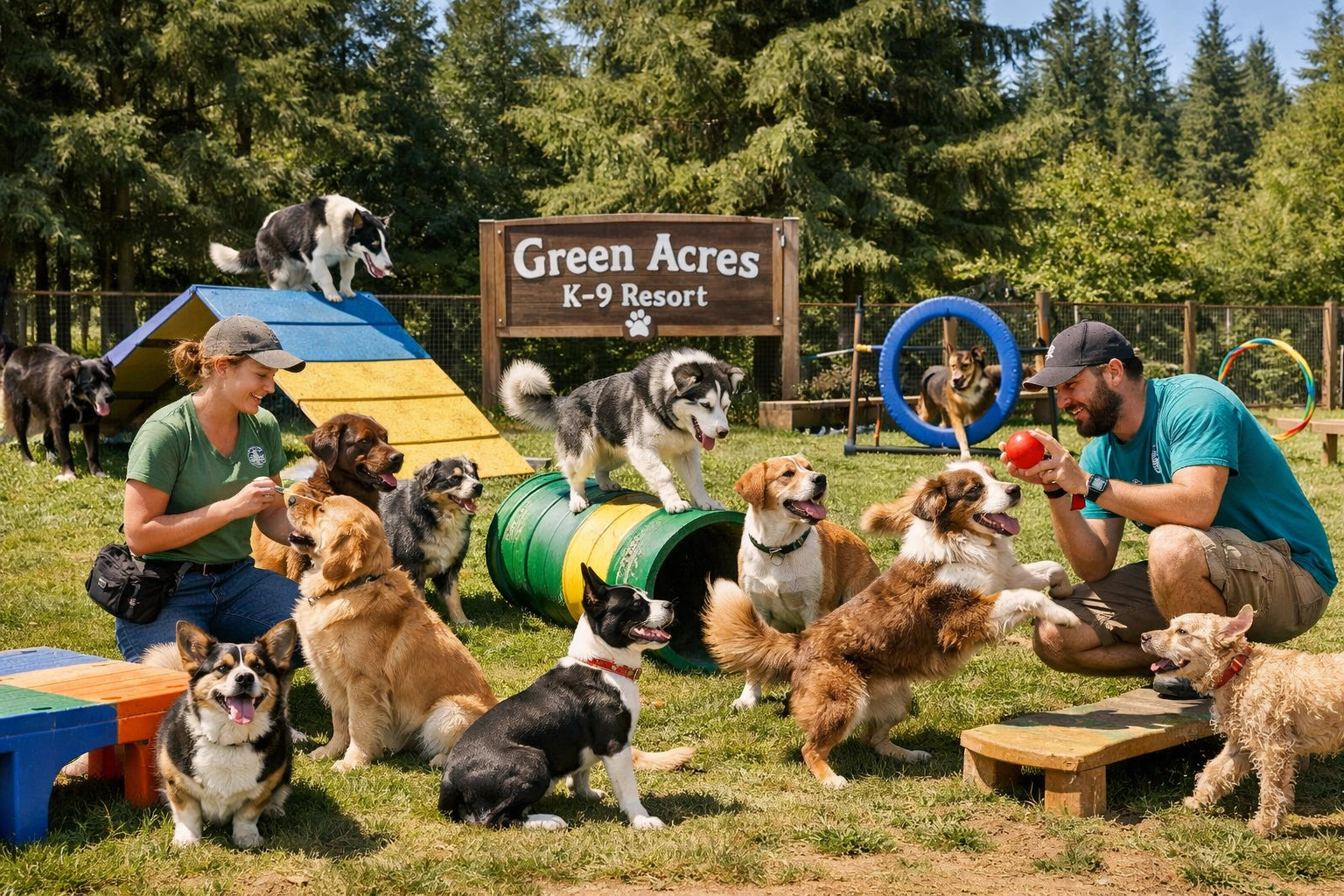
At Green Acres, we structure every day around this integration. Morning play sessions combine physical activity with social learning. Afternoon rest periods in individual spaces provide mental processing time. Enrichment activities throughout the day challenge problem-solving skills.
Your weekly home framework might look like this:
Daily (20-30 minutes): Combined activity that touches all three pillars, a walk with training breaks, a play session that involves you actively engaging, or exploration time in new environments.
3-4 times per week: Focused physical exercise, longer hikes in the Mount Hood National Forest, swimming if your dog enjoys water, or fetch sessions that incorporate directional commands.
Daily (10-15 minutes): Pure mental work, puzzle toys, hide-and-seek with treats, practicing new tricks, or scent work games.
2-3 times per week: Social opportunities, playdates with compatible dogs, trips to dog-friendly locations, or simply quality time with family members where your dog learns to relax and be present.
The Science Behind the Framework
Multiple peer-reviewed studies support this integrated approach. Research in the Journal of the American Veterinary Medical Association found that dogs receiving multi-modal enrichment (physical, cognitive, and social) showed significantly reduced signs of stress and anxiety compared to dogs receiving only one type of stimulation.
Additionally, a longitudinal study published in Animal Cognition demonstrated that dogs with varied daily routines maintained better cognitive function into their senior years than dogs with repetitive, limited activities.
We're not just making this up based on what feels good, we're applying evidence-based welfare science to create better lives for the dogs in our community.
Making It Sustainable
The biggest challenge we hear from busy Portland-area families is time. We understand, you're juggling work, kids, and life in general. The beauty of this framework is that it doesn't require hours of dedicated time. It requires intentionality.
A 20-minute walk where you let your dog sniff, practice a few sits and downs, and greet one friendly neighbor touches all three pillars. A 10-minute backyard training session before dinner provides mental and physical stimulation. A Saturday morning trip to a new trail combines everything in one outing.
And honestly? This is exactly why we created Green Acres K-9 Resort, to be part of your dog's holistic care team. When your dog spends time with us, they're getting structured, science-based activities that complement what you're doing at home. We're not replacing you; we're supporting your efforts to give your dog a complete, enriched life.
The Boring, Oregon Advantage
Living in the Boring area gives you incredible access to natural spaces perfect for this framework, from the forests and trails around Mount Hood to the quieter streets where dogs can explore without constant traffic stress. We're fortunate to have a community that values outdoor activity and animal welfare.
Your dog doesn't need a fancy facility or expensive equipment to thrive. They need you to understand that their wellness comes from balancing physical health, mental challenge, and social connection, and then consistently providing opportunities for all three.
That's the framework. That's the science. And that's what we strive to deliver every single day for the dogs in our care.
Bibliography & Sources
Comments